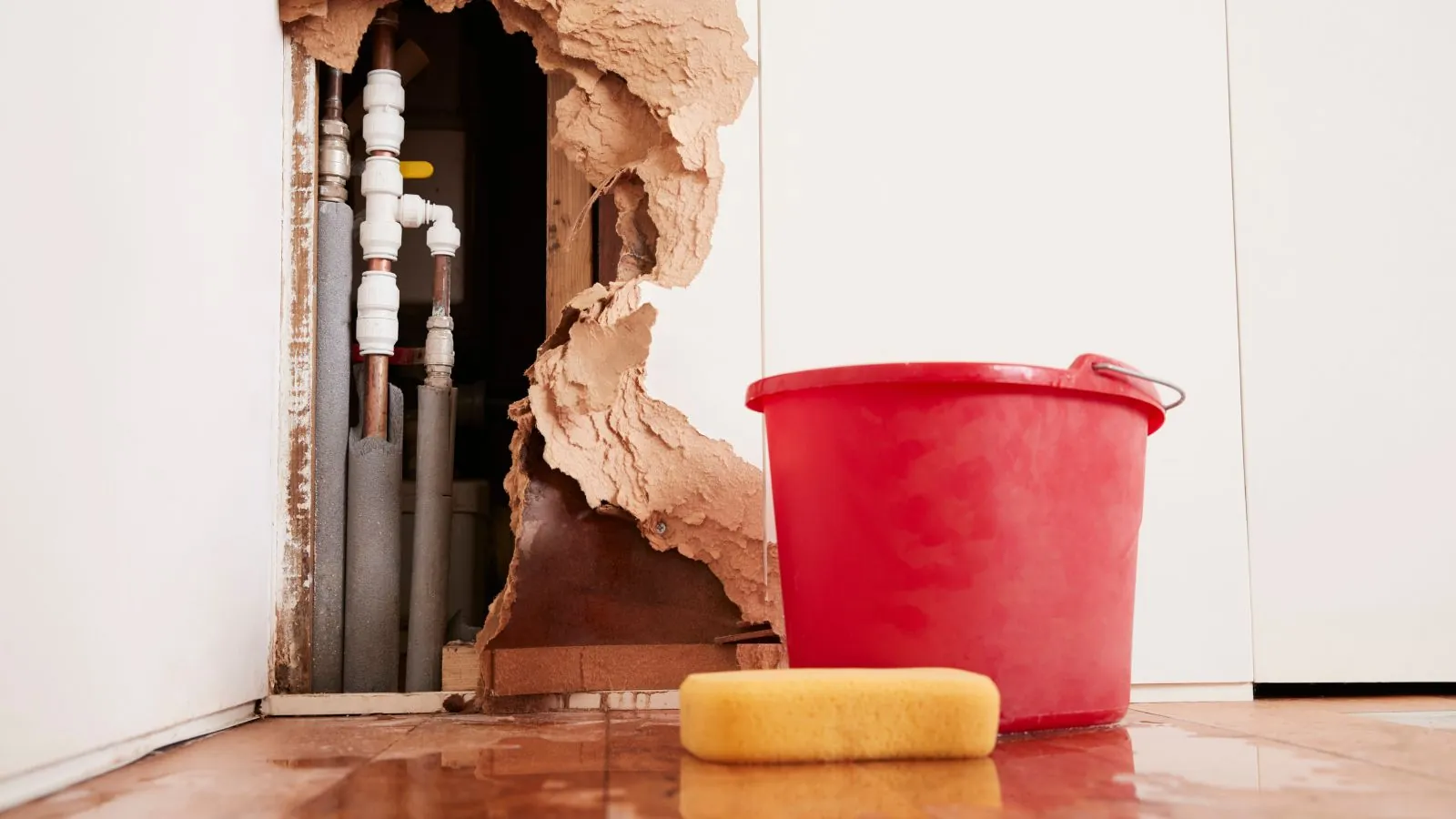
Whether to file a claim for a small leak depends on the cause, your deductible and what you cannot see. Many homeowners in Wisconsin Rapids hesitate because they worry about their premiums. That concern is understandable, and it is also a reason to gather facts before you decide, instead of deciding by instinct.
This article is general information and not legal or financial advice. Your policy and your agent decide what is covered. What follows is a way to organize the question.
Step one: find out what caused it
The cause is the first filter. The Wisconsin Office of the Commissioner of Insurance explains that water coming from the top down, such as a burst supply line, is generally covered by a standard homeowners policy, while water from the bottom up, like foundation seepage, generally needs a flood policy. Sewer backup and sump pump overflow need a special endorsement. A slow leak that went on for months may be treated differently from a sudden break.
| Cause | Often treated as | What to check |
|---|---|---|
| Sudden pipe break | Sudden and accidental | Your policy wording and deductible |
| Slow drip over months | Maintenance or wear in many policies | Exclusions for long-term leakage |
| Foundation seepage or flood | Excluded from standard homeowners | Whether you have flood coverage |
| Sewer or sump overflow | Needs an endorsement | Whether you added it |
Step two: compare cost with your deductible
If the likely repair is well under your deductible, filing may not pay anything, and it still creates a record. If the damage could be larger than it looks, a claim may be worth opening. A moisture meter and a thermal camera show how far the water traveled, and that evidence helps you compare the true size of the loss with the deductible.
Small leaks are often larger than they look. Water travels along joists, behind baseboards and into the room below. A stain the size of a plate on a ceiling can be a saturated cavity. Before you decide a leak is small, find out how far it went.
Step three: document before you decide
Documentation costs nothing to start and keeps every option open. If you wait until the damage grows, you may lose the clear record that shows when the leak began.
What to record
- Photographs of the source, the stain and any waterline, with dates.
- The failed part, kept until your insurer has seen it if it was a hose or fitting.
- Moisture readings and a written scope from the crew.
- A list of damaged items with age and approximate value.
Think about the effect on your coverage
Claims can affect renewals, and the effect varies by insurer and by loss history. Ask your agent how a claim would be recorded and whether an inquiry counts. Some people choose to pay for a small, clearly bounded repair themselves, and others file to preserve the record. Both are legitimate. What matters is that the choice rests on facts about your policy.
Reporting deadlines and prompt action
Policies commonly require prompt notice, and they expect you to limit further damage. Emergency drying is the part your policy expects you to start right away, and the cost of reasonable emergency steps is normally part of the claim. Calling your agent early to ask a question is not the same as filing, and it lets you ask what notice they need.
Where this plays out locally
Wisconsin Rapids has older housing alongside newer construction, and leaks show up differently in each. In older homes, galvanized supply lines and original fittings fail at joints. In newer homes, flexible hoses and appliance connections are the usual culprits, as covered on the appliance leak page. A slow leak behind a washer in a home in Plover can run for weeks before a floor stains.
Winter adds frozen lines. The State Climatology Office reports 33 nights per year at or below 0 degrees Fahrenheit in Wood County, and a freeze loss usually appears as a thaw-time flood, covered on the frozen pipe page. A neighbor in Nekoosa may have a different cause and a different policy, so do not assume your situation matches theirs.
A simple decision path
- 1
Stop and document
Close the valve, photograph the damage and keep the failed part.
- 2
Get readings
A crew or inspector tells you how far the water went.
- 3
Compare with the deductible
Weigh the likely repair against what you would pay first.
- 4
Ask your agent
Learn how a claim or an inquiry is recorded before you decide.
Sources
Coverage descriptions follow the Wisconsin Office of the Commissioner of Insurance flood damage FAQ. The cold-night count is from the UW-Madison State Climatology Office.
Sources: Wisconsin OCI: Flood Damage FAQ, Wood County climate profile
Small leak claim questions
Does Wisconsin have guidance on coverage for water damage?
Yes. The Wisconsin Office of the Commissioner of Insurance explains that water from the top down is generally covered by a standard homeowners policy, while water from the bottom up usually needs a flood policy, and sewer backup needs an endorsement.
Will a claim raise my premium?
It can, depending on your insurer and history. Ask your agent how they record claims and inquiries.
Do I have to file if I only call my agent?
No. Asking a question is different from filing. Ask what notice your policy requires.
What if I repair the leak myself?
You can, but keep records. Avoid permanent repairs until your insurer approves them if you are filing.
Is a slow leak covered?
Often treated differently from a sudden break. Check for long-term leakage exclusions in your policy.
Who can document the damage?
A restoration crew photographs the damage and logs moisture readings, which supports a claim either way.